Bathroom remodeling often begins with a visible goal.
Replace the tub.
Install new tile.
Update the vanity.
Improve the layout.
But demolition can reveal a very different project behind the finished surfaces.
Once tile, drywall, or a tub surround is removed, contractors may discover:
- wet insulation,
- damaged drywall,
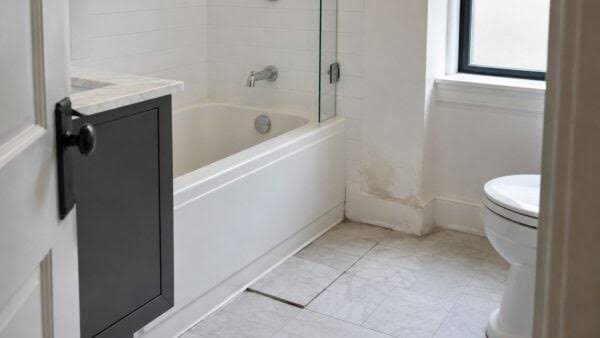
- deteriorated subfloor,
- rotted framing,
- failed waterproofing,
- old plumbing leaks.
At that point, the remodel should not simply continue as though nothing happened.
What looks like a small wet area can become a larger reconstruction issue once finishes are removed. Understanding what affects water damage restoration cost helps explain why moisture migration, damaged subfloor, framing, cabinetry and the original source of the leak can all change the scope beyond the visible stain.
The correct response is to understand the source, determine how far the damage extends, and repair the assembly before covering it with new finishes.
Why Bathroom Water Damage Often Stays Hidden Until Demolition
Bathrooms contain several potential sources of moisture:
- tubs,
- showers,
- toilets,
- sinks,
- plumbing lines.
A leak does not always create an obvious puddle.
Water can move behind:
- tile,
- wallboard,
- cabinetry,
- flooring.
Small leaks may continue for months or years before anyone notices them.
Sometimes the first visible sign appears only when demolition begins.
1. Stop Before Installing New Finishes
The worst response is to see damaged material and immediately cover it.
New:
- tile,
- flooring,
- drywall,
- cabinetry
should not be installed over unresolved moisture damage.
Doing so may hide the problem while allowing deterioration to continue.
The affected portion of the project should pause until the condition is understood.
2. Find the Source Before Repairing the Damage
Damaged material is the result.
The leak is the cause.
Repairing:
- drywall,
- subfloor,
- trim
without fixing the moisture source can lead to the same damage again.
Possible sources may include:
- leaking supply lines,
- failed shower waterproofing,
- damaged drain connections,
- toilet leaks,
- exterior moisture.
The repair should begin with identifying why the area became wet.
3. Determine How Far the Moisture Has Traveled
Water rarely respects the visible edge of a stain.
It can move:
- downward through flooring,
- horizontally through framing,
- behind wall finishes.
The damaged area may therefore extend beyond what is immediately visible.
This does not mean the entire bathroom needs demolition.
It means the repair boundary should follow the actual moisture condition rather than the cosmetic appearance.
4. Wet Drywall Is Only Part of the Problem
Damaged drywall is easy to see once demolition begins.
But the more important condition may be behind it.
Check nearby:
- studs,
- insulation,
- plates,
- plumbing penetrations.
Replacing only the wallboard may not solve the problem if moisture has reached the framing or cavity.
5. Check the Subfloor Before New Tile Goes Down
Subfloor damage is particularly important in bathrooms.
Water may enter around:
- toilets,
- tubs,
- showers,
- plumbing penetrations.
A weakened subfloor can affect the stability of the new finished floor.
Before installing tile or other rigid materials, verify that the substrate is:
- dry,
- sound,
- properly prepared.
New finishes depend on what is underneath them.
6. Soft Flooring Near a Toilet Deserves Investigation
Movement around the toilet can sometimes indicate deterioration below the finished floor.
Possible causes include:
- past leakage,
- failed seals,
- damaged subfloor.
The toilet may need to be removed to understand the condition properly.
Installing new flooring around an unresolved problem only delays the repair.
7. Rot Around a Tub or Shower Can Change the Scope
Tub and shower areas are especially vulnerable because they are exposed to frequent moisture.
Damage may occur around:
- corners,
- plumbing walls,
- tub edges,
- shower curbs.
Once framing deterioration is found, the project may require more than replacing backer board.
Damaged structural material may need repair before the waterproofing system is rebuilt.
8. An Older Tub Surround Can Hide Years of Moisture Problems
Older bathroom assemblies may have:
- failed caulk,
- inadequate waterproofing,
- deteriorated joints.
The finished surface can remain visually acceptable while moisture slowly affects material behind it.
Demolition may be the first opportunity to see the true condition.
This is especially common when an older tub surround is removed. Even a seemingly straightforward tub-to-walk-in-shower conversion can change significantly if demolition exposes deteriorated subfloor, damaged wall framing, failed waterproofing or plumbing that should be corrected before the new shower is built.
9. Plumbing Repairs and Water-Damage Reconstruction Are Different Costs
Fixing a leaking pipe and rebuilding the surrounding bathroom are not necessarily the same scope.
The plumber may repair:
- valve,
- supply line,
- drain.
But water may already have damaged:
- framing,
- drywall,
- flooring,
- insulation.
Those materials may need separate reconstruction.
This distinction helps homeowners understand why stopping the leak does not always complete the repair.
10. Check Plumbing While the Walls Are Open
Once demolition exposes plumbing, it may be worth reviewing nearby components.
This does not mean replacing everything automatically.
But accessible older:
- valves,
- connections,
- supply lines
can be inspected before new finishes make them harder to reach.
The open-wall stage is a valuable opportunity.
11. Mold Concerns Depend on Conditions, Not Just Appearance
Homeowners often see dark discoloration and immediately assume mold.
Visual appearance alone is not enough to determine the full condition.
Moisture, material type, duration, and extent all matter.
The practical priority is to:
- stop moisture,
- remove damaged material where necessary,
- allow affected areas to dry properly.
Larger or uncertain conditions may warrant professional evaluation.
12. Do Not Waterproof Over Damaged Materials
Waterproofing systems need a sound substrate.
Installing new membranes or backer systems over:
- deteriorated framing,
- unstable subfloor,
- wet material
does not create a durable shower.
The underlying structure should be repaired first.
Then the new waterproofing assembly can be installed as designed.
13. Waterproofing Is a System, Not Just a Product
A shower is not protected merely because one waterproof material was purchased.
Performance depends on details around:
- corners,
- seams,
- niches,
- penetrations,
- drains.
The entire assembly needs to work together.
This is especially important after previous moisture failure.
14. Ventilation Should Be Reviewed Too
Not every moisture problem comes from a direct leak.
Bathrooms also generate significant humidity.
Poor ventilation can contribute to repeated:
- condensation,
- paint failure,
- moisture accumulation.
If the bathroom is already being rebuilt, review whether the ventilation system is appropriate and functioning properly.
15. Hidden Damage Can Affect the Original Bathroom Budget
A remodel estimate is usually based on visible conditions and known scope.
Hidden damage can change that.
Additional work may include:
- demolition,
- drying,
- framing repair,
- subfloor replacement,
- plumbing correction,
- waterproofing changes.
This is one reason remodeling budgets should include contingency.
Unexpected conditions are not the same as optional upgrades.
16. Keep Repair Costs Separate From Design Upgrades
Suppose the homeowner discovers subfloor damage while also considering a more expensive tile.
These are two different budget decisions.
Repairing the subfloor is necessary.
Upgrading the tile is optional.
Keeping those categories separate makes it easier to control the overall budget.
17. Do Not Spend the Contingency on Finishes Too Early
Contingency exists for uncertainty.
Older bathrooms can hide problems behind:
- showers,
- tubs,
- floors.
Using the entire budget on finishes before demolition is complete can create pressure when legitimate repair costs appear.
Keep reserve funds available until the underlying conditions are known.
18. Structural Damage Needs a Different Level of Review
Most bathroom moisture problems do not become major structural events.
But if significant framing is damaged, additional evaluation may be appropriate.
This can include:
- floor joists,
- load-bearing walls,
- structural posts.
The goal is to understand whether the damage is localized or affects a larger building component.
19. Check Adjacent Rooms When Necessary
Water may travel beyond the bathroom.
An affected wall may back onto:
- bedroom,
- hallway,
- closet.
If moisture has crossed the assembly, those spaces may need investigation too.
Again, this does not mean automatically opening every adjoining wall.
Investigation should follow evidence.
20. Water Can Travel Downward
A second-floor bathroom leak may affect:
- ceiling below,
- wall cavities,
- lower-level finishes.
The location where water appears is not always directly beneath the original source.
Understanding the path of moisture helps define the correct repair area.
21. Can You Keep the Rest of the Bathroom if Only One Area Is Damaged?
Often, yes.
Localized damage does not automatically require complete bathroom demolition.
If:
- vanity,
- flooring,
- other finishes
are unaffected and can remain without interfering with repair, selective reconstruction may be possible.
But the decision should consider practical issues such as finish matching.
22. Matching Existing Tile Can Be Difficult
Older tile may be:
- discontinued,
- faded,
- from a different production lot.
If only part of a tiled area needs removal, finding an exact match can be difficult.
This can sometimes expand the finish scope even when the actual water damage is localized.
The repair plan should distinguish between:
technical repair area
and
finish replacement area.
They may not be identical.
23. Cabinetry May Be Salvageable
A vanity exposed to a small amount of moisture does not automatically need replacement.
Inspect:
- cabinet base,
- side panels,
- toe kick.
If the material remains sound, it may be preserved.
But swelling or deterioration in engineered wood products can be difficult to reverse.
24. Stone Countertops May Sometimes Be Reused
If a vanity needs rebuilding but the countertop is still in good condition, reuse may be possible.
Whether it can be removed safely depends on:
- installation,
- material,
- configuration.
This should be evaluated before demolition rather than assumed.
25. When Does the Remodel Need a Permit or Additional Inspection?
Permit requirements depend on:
- jurisdiction,
- actual scope.
Replacing finishes may be different from changing:
- plumbing,
- electrical,
- structure.
If hidden damage expands the project into work that was not originally anticipated, confirm whether additional permits or inspections are needed before proceeding.
Do not assume the original remodel scope automatically covers every newly discovered repair.
26. Do Not Close the Walls Before Required Inspections
If repair work requires inspection, keep the relevant areas accessible.
Closing:
- drywall,
- backer board,
- flooring
too early can lead to unnecessary reopening.
The project sequence should account for inspections before finishes hide the work.
27. Photograph the Damage Before Removing Everything
Documentation is useful.
Take photos showing:
- extent of visible damage,
- location,
- condition before repair.
Then photograph the area again after damaged materials are removed.
This creates a clearer record of what was found.
28. Document Repairs Before the Walls Close Again
Take another set of photos after repair.
Capture:
- framing,
- plumbing,
- waterproofing,
- subfloor.
Future homeowners or contractors may find this information valuable.
Once tile and drywall are installed, these details become invisible again.
29. Keep Product Information for the New Waterproofing System
Bathroom repairs often involve new:
- membranes,
- backer materials,
- sealants.
Save:
- product names,
- installation information,
- warranty details.
This is especially useful if future work involves the same shower or bathroom.
30. Do Not Rush Drying
New finishes should not trap excessive moisture inside the assembly.
Affected areas may need enough time to dry before reconstruction.
The required drying period depends on:
- material,
- extent,
- conditions.
The schedule should follow the condition of the building, not an arbitrary desire to install tile immediately.
31. A Delay During Demolition Can Prevent a Much Larger Problem
Discovering water damage can feel like the project is falling behind.
But pausing to correct it is usually much less disruptive than discovering the same problem after:
- new tile,
- new cabinets,
- new paint
have already been installed.
The short-term delay protects the investment in the new bathroom.
32. Rebuild the Assembly, Not Just the Visible Surface
The strongest repair restores the entire sequence.
For a shower wall, that may mean considering:
- framing,
- substrate,
- waterproofing,
- tile.
Replacing only the final visible layer leaves the real problem unresolved.
Bathrooms perform as assemblies.
The finishes are only the last part.
33. Use the Discovery to Improve the New Bathroom
Unexpected damage does not have to be purely negative.
Once the bathroom is open, homeowners may have an opportunity to improve:
- waterproofing,
- plumbing access,
- ventilation,
- framing.
The goal should not be to expand the project unnecessarily.
But if an area already requires reconstruction, rebuilding it correctly can reduce future risk.
34. Avoid Repeating the Original Weak Detail
If the leak resulted from a poorly designed condition, do not recreate that same detail.
For example, consider whether the previous failure involved:
- bad transition,
- inadequate waterproofing,
- inaccessible plumbing connection.
The new design should correct the underlying weakness.
35. Ask What Caused the Damage, Not Just What Was Damaged
This question keeps the project focused.
Instead of only asking:
“Which materials need replacement?”
also ask:
“Why did they fail?”
That distinction is what prevents a cosmetic repair from becoming a temporary repair.
What Should Be Documented Before the Walls Are Closed Again?
Before reconstruction disappears behind finishes, homeowners should retain records of:
- repaired framing,
- new plumbing,
- waterproofing,
- subfloor replacement,
- inspections where applicable.
Take wide photos so the location is clear.
Then take closer photos of important details.
Store them with:
- plans,
- permits,
- product information.
A Bathroom Remodel Can Change Once the Building Is Open
No contractor can see every concealed condition before demolition.
Bathrooms are particularly prone to hidden moisture because water and plumbing are concentrated in a relatively small area.
That is why a project that begins as:
“replace the tub and tile”
can occasionally become:
“repair the subfloor, fix the leak, rebuild the shower assembly, then install the new finishes.”
That change is frustrating, but ignoring the problem would be worse.
The right sequence is:
find the moisture source → determine the damage → remove what cannot remain → dry and repair the assembly → complete necessary inspections → rebuild the bathroom.
New tile should be the last step in solving a moisture problem, not the first step in hiding it.
When hidden damage is repaired correctly while the bathroom is already open, the homeowner gets more than a better-looking room.
They get a bathroom built on materials that are actually ready to support the new finish.